

Future-Proof Careers: What Will Still Be Relevant in 2030?
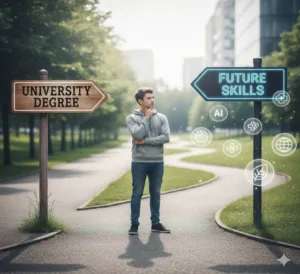
With AI, automation, and global uncertainty reshaping jobs, students are no longer just choosing universities; they’re choosing long-term relevance. The smartest decisions today start with understanding which skills and careers will still matter in 2030.
From 400+ student profiles we reviewed this year, career anxiety around “AI replacing jobs” has overtaken concerns about college rankings.
- Jobs Won’t Vanish, Tasks Will
- Automation targets tasks, not entire professions.
- Roles are being redesigned to include AI oversight and decision-making.
- Job titles remain; expectations evolve.
Micro-insight: ~70% of employers now list “ability to work with AI tools” as a preferred skill, even in non-tech roles.
2. Hybrid Careers Are Becoming the Norm
- Demand rising for AI + Design, Tech + Healthcare, Business + Analytics.
- Employers want professionals who bridge disciplines.
- Pure single-skill profiles face faster obsolescence.
Micro-insight: Top global universities report strongest placement outcomes from interdisciplinary programs.
- Data Literacy Is Now Career Survival
- Understanding data matters more than building algorithms.
- Skills include interpreting dashboards, trends, and insights.
- Applies to psychology, economics, marketing, and public policy.
Micro-insight: Students with basic data skills see ~30–40% better employability outcomes for post–graduation.
4. Human Skills Are Becoming More Valuable
- Critical thinking beats automated outputs.
- Communication, negotiation, and leadership remain irreplaceable.
- Ethical judgment is increasingly demanded across industries.
Micro-insight: Employers rate “problem-solving” above technical skills in early-career hiring.
- Healthcare & Wellbeing Will Keep Expanding
- Aging populations drive sustained global demand.
- Growth in public health, mental health, and health-tech roles.
- AI assists diagnostics but cannot replace care delivery.
Micro-insight: Healthcare-related degrees show among the lowest unemployment rates globally.
- Sustainability Is No Longer a ‘Niche’
- Climate action, ESG, and sustainability roles are mainstream.
- Businesses need professionals who combine impact + strategy.
- Green skills are embedded across engineering, finance, and policy.
Micro-insight: Sustainability-linked roles are growing faster than traditional business roles worldwide.
- Adaptability Is the Ultimate Career Insurance
- Linear career paths are disappearing.
- Reskilling every 5–7 years is becoming standard.
- Learning agility matters more than static expertise.
Micro-insight: Students with flexible skill portfolios transition jobs faster during market downturns.
- EducationMust Support Skill Growth
- Rankings alone don’t ensure employability.
- Look for applied learning, internships, and industry exposure.
- Career outcomes matter more than brand perception.
Micro-insight: Programs with strong industry integration report higher post-study employment success.
The safest career choice isn’t avoiding AI, it’s building skills that evolve alongside it. Students who focus on adaptability, interdisciplinary learning, and human judgment will remain relevant well beyond 2030.
ReachIvy sincerely hopes that this article serves as a critical tool to increase your knowledge base. For study abroad consultation or career counselling with ReachIvy, Submit a Query now! Also, review our resources section to access our free premium content.
Check out our books: Break the MBA Code and Break the Career Code by Vibha Kagzi.
For personalised study abroad and career guidance,
Submit a Query
with
ReachIvy.com.
Use an AI-powered career and higher education co-pilot, Buy now with
HelloIvy.ai.