

UCAS Personal Statement 2027: How to Answer All 3 Question
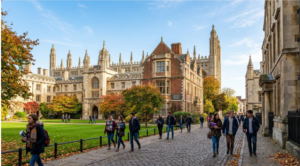
Applying to UK universities for 2027 entry? Your UCAS personal statement now has a different structure: instead of one long essay, you must answer three set questions. However, all three answers are read together, so repeating the same achievements can weaken your application. Here’s how to use each section to build one convincing picture of your academic interests, preparation and potential.
Key fact: You have 4,000 characters, including spaces, across all three answers. Each answer must contain at least 350 characters.
-
Understand the Three UCAS Questions
The new format applies to 2027 entry. The questions are:
- Question 1: Why do you want to study this course or subject?
- Question 2: How have your qualifications and studies helped you prepare?
- Question 3: What else have you done to prepare outside education, and why are these experiences useful?
Remember: You are writing one personal statement for all your UCAS choices, not a separate essay for each university.
-
Make Question 1 About Your Motivation
This is where you explain why the subject interests you and what you want to explore further.
- Identify a specific question, topic, book, project or experience that sparked your interest.
- Explain what you learned and what you want to understand next.
- Connect your interest to the course—not just to a future job title.
Avoid: Saying you have always been passionate about business, law or psychology without showing what sparked that interest.
-
Use Question 2 to Show Academic Readiness
Admissions teams want evidence that you can handle the subject at university level.
- Link relevant school subjects to the course you plan to study.
- Discuss a research project, assignment, practical task or concept that challenged you.
- Explain the skills you developed, such as analysis, problem-solving or independent research.
For Indian applicants: Do not simply list CBSE, ISC or IB subjects and predicted grades. Explain how your learning has prepared you for the chosen degree.
-
Give Question 3 a Different Purpose
This section is about preparation beyond formal education. It is not a list of extracurricular certificates.
- Include internships, volunteering, competitions, independent projects or relevant hobbies.
- Explain what you did, what you learned and why it matters to your course.
- If you lack formal work experience, use meaningful self-directed learning or personal projects.
Example: A student applying for architecture could discuss a building-design project, explain the choices made and reflect on what it taught them about space and function.
-
Avoid Repeating the Same Evidence
The three questions are reviewed as one personal statement, not as three unrelated essays.
- Give each experience one main purpose. A coding project might demonstrate academic preparation in Question 2, while an independent app built outside school could fit Question 3.
- If an experience genuinely supports two points, use a different insight rather than retelling the same story.
- Read all three answers together. Do they add new information at each stage?
-
Remember: One Statement, Multiple Courses
This is especially important if your five UCAS choices include different but related courses.
- Look for the common academic thread between your choices.
- Focus on shared subject interests rather than naming individual universities.
- Check that your examples make sense for every course on your list.
- If your choices are very different, reconsider whether your course selection is coherent.
Important: Universities may have their own guidance on what they expect to see. Check individual course requirements before submitting.
-
Review Before You Submit
Once your answers are complete, check more than grammar and spelling.
- Confirm that every answer meets the 350-character minimum and the total stays within 4,000 characters.
- Remove unsupported claims, copied phrases and achievements that add little to your application.
- Make sure your examples are genuine and that you can discuss them confidently in an interview.
- Use AI for brainstorming or proofreading, not to invent experiences or replace your own voice. UCAS also provides guidance on responsible AI use.
For most 2027 undergraduate courses, the UCAS equal consideration deadline is 13 January 2027, 6pm UK time. Use the time before then to build a personal statement that is specific, coherent and genuinely yours.
For personalised study abroad and career guidance,
Submit a Query
with
ReachIvy.com.
Use an AI-powered career and higher education co-pilot, Buy now with
HelloIvy.ai.